Gongs Handcraft
How the gongs are made
At Universe Gong, each gong is crafted entirely by hand, guided by technical rigor, refined auditory sensitivity, and a deep mastery of fire as a transformative element.
The process begins with the careful selection of the metal alloy, chosen according to its acoustic properties, structural resistance, and vibrational responsiveness. After cutting and preparing the metal sheet, it is subjected to controlled heating. Fire plays a fundamental role at this stage: by raising the temperature to the precise point of malleability, it allows the material to become sufficiently plastic to be shaped without compromising its structural integrity.
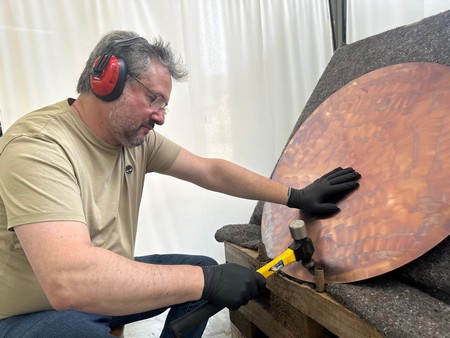
The manual forming phase follows. Through successive hammering, executed with technical precision, the metal surface is gradually modeled. Each strike contributes not only to defining the physical curvature but also to shaping the acoustic behavior of the instrument. The form and tension of the material determine the frequency spectrum, the richness of overtones, and the overall sonic depth.
This process is not linear. The metal is repeatedly heated and worked in a continuous cycle of fire and shaping. Attentive listening guides each technical decision. Subtle variations in density, thickness, or surface tension can produce significant changes in the sonic outcome, requiring a high level of experience and auditory discernment.
Tuning is carried out manually through progressive adjustments to the surface structure. It is a meticulous task in which millimeters influence the overall harmonic response. The objective is to achieve balance between the fundamental tone and its overtones, ensuring vibrational coherence and acoustic stability.
The final finish preserves the marks of the artisanal process, bearing witness to the action of fire and human intervention. These marks are not imperfections, but rather evidence of the authenticity of the construction method.
Each Universe Gong therefore results from the interaction of three essential elements: the metallic material, fire as the agent of transformation, and skilled human craftsmanship. The instrument that emerges from this process is not merely a sound object, but the material expression of a technical, thermal, and acoustic journey conducted with intention and precision.